Here's a confession to start us off: when I sat down to write the next Jones Files book, the plan was to keep things sensible. Tidy. A nice contained archaeological thriller, maybe a vault, maybe a stone, the usual ancient horror humming away under somebody's vineyard. You know — the kind of book a reasonable man writes.
One afternoon, I opened some of my old notebooks, which contained notes from ten years ago. And there was a note about a gang of grave robbers. It's one of those ideas that just keeps spinning around in my head, and I can't seem to shake it.
Then I made the mistake of reading about the Battle of Cannae, there was just a loud click and that was the end of being reasonable.
If you don't know Cannae: in 216 BCE, Hannibal Barca took a smaller army, let his own center deliberately collapse and watched eighty thousand Romans march straight into the trap. By the end of the afternoon, tens of thousands of men were dead in a single field. Not over a campaign. Not over a war. An afternoon. It is still taught in military academies. It is still, two thousand years later, the textbook definition of "this went catastrophically well for exactly one of the people involved."
So naturally I thought: what if someone watched?
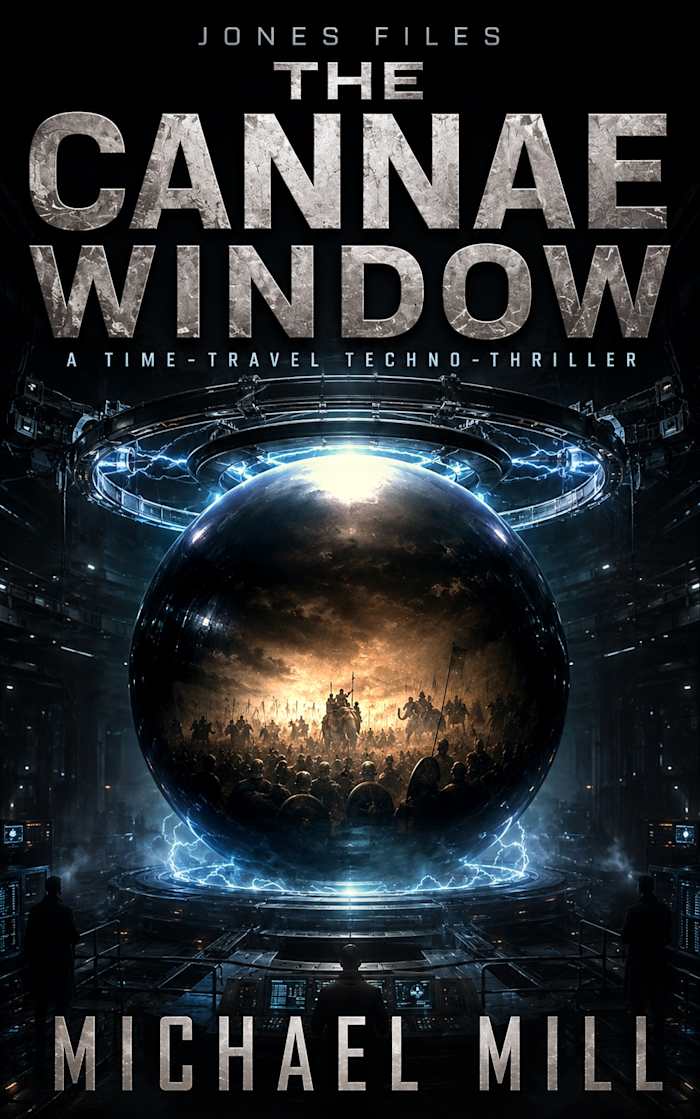
The Cannae Window is what happened next, and it is the biggest, strangest, most ambitious thing I've written. The premise, without giving away the good parts:
A team of scientists works out that time has a particle. Find the particle, you can find the field. Master the field, and you can lock the present moment onto a moment in the deep past — provided that moment screamed loudly enough to leave a scar. Cannae, as it turns out, is still ringing.
The catch — there's always a catch — is that the bridge stays open for exactly twenty-eight days. After that, the universe quietly tidies up after itself. Anything that shouldn't be there gets unhappened. Which is a wonderful arrangement for a research team that just wants to observe a battle and go home, and a considerably less wonderful arrangement for a research team that decides, while standing several hundred meters above the richest unguarded treasury in the ancient world, that the rules don't really apply to things that are going to reset anyway.
Reader, the rules apply.
Abner Jones is back, Manius still riding shotgun in his skull and getting louder. But the soul of this one belongs to Dr. Zara Moreno — linguist, the only person on the mission with a functioning conscience, and the woman who ends up doing the one thing nobody planned for: standing in front of Hannibal Barca and refusing to lie to him. What grows between those two is the part I'm proudest of and the part I'm least willing to spoil. I'll only say this: it is not a romance in the soft sense. It's two very dangerous, very intelligent people recognizing each other across two thousand years and a countdown clock, both of them knowing exactly how little time the universe is prepared to allow it.
There's also a black sphere hanging over the battlefield like a second moon that refuses to fall, an ancient mercenary called the Jackal who works out faster than anyone should that miracles have throats you can cut, a teenage Roman officer named Scipio who is having the worst week of a life that history has much bigger plans for, and at least one faction at Cannae that has no business being there at all.
I did the homework, by the way. The history is real where it can be — Livy and Plutarch did a lot of the heavy lifting, and I went back to the sources rather than the modern translations so I could get the texture right: the heat, the dust, the flies, the particular horror of men packed so tightly they can't fall down when they die. The physics is invented but built to sound like it might keep a CERN scientist up at night. Where I bent the truth, I'll own up to it in the afterword. Where history goes quiet — and history goes very quiet about a few things at Cannae — well. That's where the wound is. That's where I went digging.
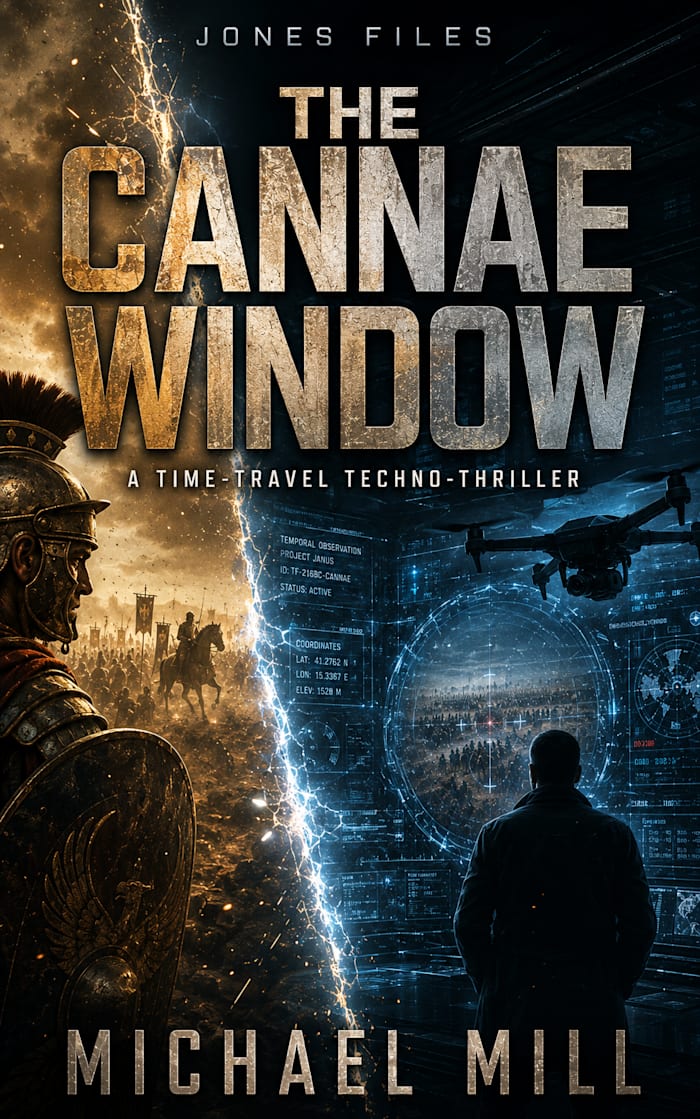
This is Crichton's "what if the science were real" colliding with the dread of serious historical fiction, and it's meaner and sadder than anything I've done. If you came to the Jones Files for buried tech and impossible artifacts, it's all here. But I think you'll stay for the question underneath it, the one the whole book is built around:
If history resets in twenty-eight days — if every footprint is erased and nobody is left to remember — does any of it still matter?
I have a view on that. So does Zara. You might not like the answer.
Fair warning, in the tradition: you'll come for the time machine and Hannibal's lost gold. You'll stay because you've started to suspect, somewhere around the middle, that the past is not safe to visit, and that it has never once forgiven a trespasser.
See you at the river.
— Michael
PS
You can find The Cannae Window here.