There’s a photograph from 1941 that a certain kind of person cannot look at without feeling a small electric jolt behind the eyes.
It was taken at the reopening of a bridge in Gold Bridge, British Columbia — a routine bit of small-town ceremony, the sort of thing that fills a page in a local archive and is never thought of again. A crowd stands watching. Everyone wears the fashion of the day: fedoras, wool suits, the buttoned formality of the war years. Everyone, that is, except one young man near the front. He’s in a printed sweater with a stitched emblem, wraparound sunglasses, and he’s holding what looks, at a glance, like a compact modern camera. He seems to have wandered in from another decade entirely — as if he stepped through a door somewhere in the future, snapped a picture of the past, and simply forgot to change his clothes.
That man has a name now, on the internet at least. They call him the Time-Traveling Hipster. And he’s in good company, because for as long as people have imagined slipping loose from the river of time, other people have claimed it actually happened — to them, to a stranger in a morgue, to a soldier posting on a message board at two in the morning.
What follows is a field guide to the most famous of these stories. Some are hoaxes with a paper trail. Some are honest misunderstandings. A few remain genuinely strange, resisting every tidy explanation thrown at them. All of them tell us something about why the idea of a rip in time refuses to leave us alone.
A word before we begin: none of these accounts has ever been verified, and most have been thoroughly explained by ordinary means. Treat them the way you’d treat a good ghost story told by someone you like — enjoy the chill, but keep one hand on the light switch.

The Message-Board Prophet: John Titor
Let’s start with the one that launched a thousand forum threads.
In the autumn of 2000, a user calling himself TimeTravel_0 appeared on the Time Travel Institute’s online forums. By early 2001 he’d adopted the name John Titor, and over roughly four months he told an extraordinary story with an engineer’s flat, unhurried confidence. He was, he said, a soldier from the year 2036, stationed near Tampa, Florida, in a nation shattered by civil war and a nuclear exchange that had killed billions. His mission had brought him back to 1975 to retrieve an IBM 5100 computer — a genuinely obscure machine — because it possessed an undocumented ability to emulate older systems, which his future needed to fix a looming software catastrophe. (Programmers will recognize a nod to the real “Year 2038 problem,” a date-formatting bug baked into a lot of legacy software.)
His stop in the year 2000 was personal, he claimed: to collect old family photos and visit relatives before the world fell apart.
What made Titor stick wasn’t the doom. It was the texture. He posted diagrams of his “gravity distortion” machine, answered technical questions patiently, and warned people about mad cow disease and a coming American conflict. He also gave himself a brilliant escape hatch: he insisted the many-worlds interpretation of quantum physics was correct, so his timeline and ours might simply diverge. When his predictions failed — no civil war by 2004, no nuclear war in 2015 — a believer could shrug and say he was never talking about our world.
An IBM engineer named Bob Dubke later confirmed that the 5100 really did have the little-known capability Titor described, which sent chills through the faithful. Skeptics pointed out that this fact had been published and was findable online before Titor ever posted. A 2009 investigation traced the whole affair to a Florida entertainment lawyer, Larry Haber, and his tech-savvy brothers. Titor’s last post, in March 2001, was a shrug of advice: bring a gas can when your car dies on the roadside. Then he was gone.
He never came back. But the legend outgrew him — inspiring the beloved anime Steins;Gate, a small library of books, and a fandom that still parses his old words like scripture.
The Ship That Vanished: The Philadelphia Experiment
Some legends are born from a single, strange man. This one was born from Carl M. Allen — a drifter who sometimes called himself Carlos Allende, and whose own family described him as a master leg-puller.
In the mid-1950s, Allen sent a UFO researcher named Morris K. Jessup a series of letters, along with a copy of Jessup’s own book scribbled full of eerie marginal notes in three colors of ink, seemingly written by three different people. The claim inside was unforgettable: in October 1943, at the Philadelphia Naval Shipyard, the U.S. Navy had tried to make the destroyer escort USS Eldridge invisible. The experiment, the story went, worked far too well. The ship didn’t just vanish from radar — it disappeared entirely, teleported to Norfolk, Virginia, and back. And when it returned, some crewmen were said to be embedded in the steel of the deck, others driven violently insane, one walking through a wall at his own dinner table never to be seen again.
The Navy has always flatly denied it. The dates don’t fit the Eldridge’s documented movements. The physics don’t exist. A far more mundane explanation sits close at hand: ships in that era were “degaussed” — their magnetic signatures scrambled to protect against magnetic mines — and a green glow around a ship could be St. Elmo’s fire, a real electrical phenomenon. Allende’s story is understood today as a hoax, and Jessup, his reputation crumbling, died by suicide in 1959.
And yet the tale would not stay buried. It birthed a movie, a sequel, and something even stranger — a sequel of its own, out on Long Island.
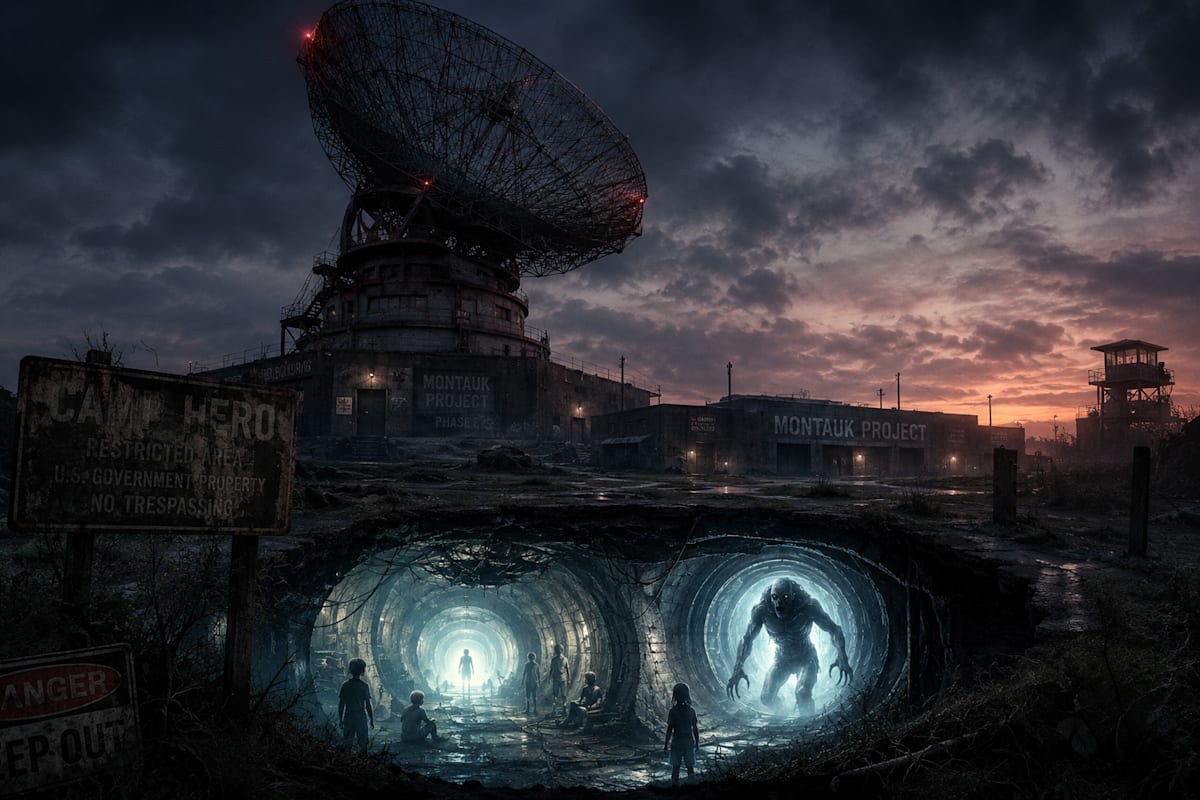
The Base Beneath the Radar Tower: The Montauk Project
At the eastern tip of Long Island, behind rusting fences, stands Camp Hero — a genuinely real, genuinely decommissioned military base with an old radar dish that looks like a prop from a Cold War fever dream. That reality is the hook on which one of the wildest conspiracy theories in America hangs.
Beginning with Preston Nichols’s 1992 book The Montauk Project: Experiments in Time, believers claim that the surviving scientists of the Philadelphia Experiment continued their work underground here: time tunnels, teleportation, mind control, psychic children who could pull objects out of thin air, even contact with extraterrestrials and a monster that came howling through a portal. Two men, Al Bielek and Duncan Cameron, claimed to have leapt from the deck of the Eldridge in 1943 and landed at Montauk in 1983, where they said they met the physicist John von Neumann — despite his being documented as dead since 1957.
Nichols himself hedged, writing that readers could take his book as science fiction or non-fiction. Investigators note it reads exactly like fiction dressed in real photographs. But the base was real, and government secrecy was real, and that thin thread of truth has kept the story alive for three decades.
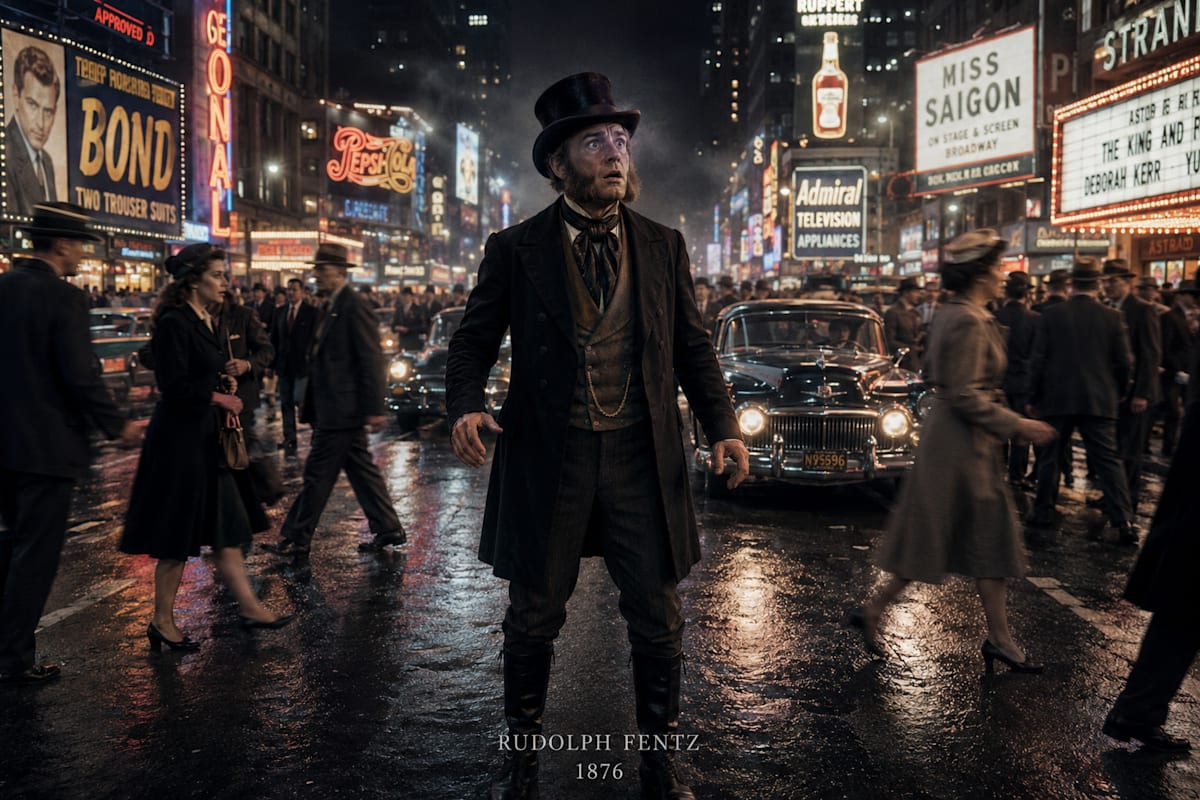
The Man in the Wrong Century: Rudolph Fentz
Here is the story most often told as ironclad proof.
One June night in 1950, a man appeared in the middle of Times Square. He was perhaps thirty, dressed in Victorian clothes — muttonchop sideburns, a silk hat, buttoned shoes — and he stood gaping at the neon and the cars like a man who had never seen either. Panicked, he bolted into traffic and was struck and killed. In his pockets: banknotes decades out of circulation but crisp as new, a nickel beer token from a saloon nobody could place, a bill for the boarding of a horse, and cards bearing the name Rudolph Fentz. A dogged NYPD captain named Hubert Rihm traced the name to a widow in Florida, whose father-in-law, Rudolph Fentz, had walked out one evening in 1876 and never returned. The 1876 missing-persons file matched the body in the morgue exactly.
It’s a perfect story. It’s also fiction.
The folklorist Chris Aubeck untangled it: every detail comes from “I’m Scared,” a 1951 short story by Jack Finney (author of The Body Snatchers), published in Collier’s magazine. In 1953 a man named Ralph Holland reprinted the tale in a booklet — stripping away all indication it was fiction — to promote belief in a “fourth dimension.” From there it slipped its moorings and drifted for decades through paranormal literature as fact. Captain Rihm never existed. Neither did Fentz. But the story is so well-built that people still argue for it today.
Two Women at Versailles: The Moberly-Jourdain Incident
On a hot August afternoon in 1901, two respectable English academics — Charlotte Anne Moberly and Eleanor Jourdain, both associated with St. Hugh’s College, Oxford — went walking in the gardens of Versailles, looking for the Petit Trianon, Marie Antoinette’s private retreat.
They got lost. And as they walked, they later wrote, the day changed around them. A heavy, dreamlike oppression settled over everything. The air went still and flat, “as if we were walking in a dream.” They passed men in long grayish-green coats and three-cornered hats, an abandoned farmhouse with an old plow, a repulsive pockmarked man by a pavilion. Moberly saw a fair-haired woman in an old-fashioned summer dress sketching on the grass — a woman she later became convinced was Marie Antoinette herself. Jourdain, walking beside her, saw no such woman at all.
The strangeness lifted the moment they reached the house and rejoined a crowd of ordinary tourists.
For the next decade, the two women researched obsessively, publishing their account in 1911 as An Adventure. They found, they claimed, that the plow, the costumes, even a scrap of music Moberly heard on a later visit, all matched the Versailles of Marie Antoinette’s era — details absent from the gardens of 1901. They concluded they’d stepped into the queen’s own memory of a doomed August day. Skeptics have offered gentler explanations: two suggestible women, steeped in French history, misreading an ordinary walk — or perhaps stumbling onto a costumed rehearsal staged by the eccentric poet Robert de Montesquiou, who kept an apartment nearby. The debate has outlived everyone involved.
The Trader Who Bet Too Well: Andrew Carlssin
In March 2003, a story ricocheted around the early internet: a man named Andrew Carlssin had been arrested by the SEC after turning an $800 investment into over $350 million across 126 flawless high-risk trades. Under questioning, the story went, he broke down and confessed the impossible — he was a time traveler from two centuries in the future, and he’d simply invested with foreknowledge of the markets. He offered the location of Osama bin Laden and a cure for AIDS in exchange for leniency. A mysterious benefactor posted his bail, and Carlssin vanished before his court date. Records showed he’d never existed at all.
He never existed because the story ran first in the Weekly World News, the supermarket tabloid famous for Bat Boy and alien endorsements of presidential candidates. It was satire. The trouble came when Yahoo! News reprinted such pieces without flagging their origin, and readers who didn’t know the source took the bait. From there it spread, gaining lurid new details with every retelling.

The Man Under the Sink: Håkan Nordkvist
In 2006, a Swedish man named Håkan Nordkvist posted a video with a delightfully domestic premise. He’d been fixing a leak under his kitchen sink, he said, when the cabinet seemed to stretch away from him. He crawled in, a white light swallowed him, and he emerged in the year 2046 — where he met a healthy, calm, 70-something version of himself. As proof, the two Håkans filmed themselves comparing matching tattoos on their arms.
It’s charming, and it was an advertisement. The whole thing was a campaign for the Swedish pension firm AMF, whose message was, essentially: plan for the future, because you’ll meet yourself there someday. Which, as marketing metaphors go, is almost too clever.
The Soviet in Kyiv: Sergei Ponomarenko
This one is a favorite in the “convincing” tier, though its documentation is thin and its origins murky.
The story goes that in April 2006, police in Kyiv detained a confused young man in outdated clothes, carrying an antique camera and asking for a street that no longer existed. He kept asking what year it was. He identified himself as Sergei Ponomarenko and said he was from 1958 — and his identity card, supposedly, was Soviet-issued, listing a birth year of 1932, though he looked barely thirty. He claimed he’d been walking with his fiancée, photographed a strange bell-shaped object in the sky, and been flung forward in time by the flash. Sent to a psychiatric clinic, he was reportedly caught on camera returning to his room one evening — and then simply vanished from it.
No verifiable records support any of it, and the tale has all the hallmarks of a crafted legend rather than a documented event. But it’s told well, and that’s often enough.
The Man Who Built a Machine: Mike “Mad Man” Marcum
Not every time-travel figure vanished into legend. Some are matters of public record — just not the parts they’d want you to believe.
In 1995, a caller named Mike Marcum told Art Bell’s Coast to Coast AM that he was building a time machine from a Jacob’s ladder — those crackling arcs of electricity you’ve seen in old science films. To power a larger version, Marcum admitted he’d stolen transformers from the local power company in King City, Missouri, and blacked out part of the town. That part is verifiably true: he was arrested and sentenced for it. He called back in 1996 claiming to be a month from completing a new machine, said he’d sent objects and small animals through it, and then dropped out of sight in 1997 — feeding a swarm of urban legends about where, or when, he’d gone.
Years later, in 2015, he resurfaced on Bell’s later show to explain: he’d been flung two years into the future and hundreds of miles away, waking up near Fairfield, Ohio, with amnesia, slowly rebuilding his identity in a homeless shelter. The Missouri State Highway Patrol has no record of him ever being reported missing.
Chaplin’s Cellphone
In October 2010, an Irish filmmaker named George Clarke posted a video that briefly conquered the internet. It examined a scene from the DVD extras of Charlie Chaplin’s 1928 film The Circus — footage of the Los Angeles premiere. In it, a heavyset woman walks past the camera holding something to the side of her head, apparently talking into it. A cellphone, Clarke suggested. In 1928. A time traveler caught on film.
The clip drew millions of views and serious news coverage. The likeliest answer is quieter: a portable hearing aid, a technology just emerging in that era, or possibly an ear trumpet. There’s no one on the other end of that call — because there’s no call.
The Beach Photo and the Painted iPhone
The Chaplin clip was the first of a whole genre: the anachronism hunt, in which the internet zooms into old images looking for the future hiding in the frame.
A genuine 1943 photograph of holidaymakers on Towan Beach in Newquay, Cornwall, went global in 2018 when viewers decided a man appeared to be absorbed in a mobile phone. The photographer who’d uploaded it offered a flatter explanation: the man was almost certainly rolling a cigarette. And an 1860 painting by the Austrian artist Ferdinand Georg Waldmüller, The Expected, shows a young woman walking a country path, gazing down at a small object in her hands — which excitable viewers pronounced a smartphone. Art historians identified it, patiently, as a prayer book or hymnal, precisely the sort of thing a churchgoing young woman of 1860 would carry.
The lesson these cases keep teaching is a humbling one: the past was full of small handheld objects, and our own moment is so saturated with screens that we see them everywhere, even where they cannot be.
The Monk’s Time Camera: The Chronovisor
Not all these devices were built to carry a traveler. Some, allegedly, only watched.
An Italian Benedictine monk named Pellegrino Ernetti claimed in the mid-20th century that he and a team of scientists had built a “chronovisor” — a machine that could tune into the past like a television, viewing and filming events long gone. Among its supposed harvests: a photograph of the crucifixion of Jesus and a viewing of a lost Roman tragedy. The claim collapsed under inspection. Another magazine revealed that Ernetti’s “Christ” was a reversed image of a postcard sold at an Italian sanctuary, and doubt was cast on the rest. An apparent deathbed confession later surfaced. One scholar has suggested the whole idea was lifted from a 1940s science-fiction story about a machine that films the biographies of the dead.
The Nazi Bell: Die Glocke
Among the murkier legends is Die Glocke — “The Bell” — a supposed secret Nazi device, described in fringe literature as a bell-shaped machine involved in exotic physics and sometimes cast as an antigravity craft or even a time machine. The evidence for it is a chain of unverifiable claims tracing back largely to a single author, with nothing solid beneath. It endures mostly because “secret Nazi wonder-weapon” is one of the most reliably magnetic phrases in all of conspiracy culture.
The Warp-Generator Spammer: “Bob White”
For a couple of years around 2001–2003, a strange email circulated to inboxes worldwide. The sender was hunting for a “Dimensional Warp Generator” and other exotic components. Sometimes he claimed to be a time traveler stranded in the present; sometimes he claimed to be seeking parts only from fellow travelers. Pranksters played along — one set up a fake online shop and “sold” him a warp generator repurposed from a hard-drive motor.
The man behind the emails, journalist Brian McWilliams discovered, was a real person named Robert Todino, who genuinely believed he needed to get home to the past and who had been diagnosed with serious psychiatric conditions. It’s the one story on this list that curdles from funny to sad the moment you learn the truth — a reminder that behind some “time travelers” is a person in real distress, and the humane response is compassion, not mockery.
The Government That Almost Had One: Iran, 2013
In April 2013, an Iranian news agency reported that a young scientist had invented a machine that could see into the future — not move through time, but read it, printing out a person’s fate years in advance. Within days the story was quietly pulled and replaced with a government official’s denial that any such device had ever been registered. What it was — an overhyped student project, a mistranslation, a bit of national boosterism — was never fully clear. But for a few days, a nation had a time machine, and then it didn’t.
The Contactee’s Photographs: Billy Meier
The Swiss farmer Eduard “Billy” Meier is best known for decades of UFO photographs, but his claims stretch into time as well: he has said he traveled through time and space with his extraterrestrial contacts, even producing photos he described as glimpses of the distant past and future. Analysts have identified some of his “future” and “past” images as reworked pictures from magazines and other mundane sources. His supporters remain devoted; his critics point to a long trail of debunked props. Either way, he belongs in any honest catalog of modern time-travel claimants.
The TikTok Prophets
Which brings us, inevitably, to now.
The time traveler has migrated from the naval shipyard and the message board to the vertical video. Accounts like Eno Alaric’s — posting under the handle @theradianttimetraveller — rack up followers by claiming to broadcast from the year 2671, warning of tsunamis, alien wars, twin planets, and dimensional portals, each dated with confident precision. The dates pass. The tsunamis don’t come. Followers point this out in the comments, and the account posts a fresh prophecy the following week.
It’s the John Titor formula stripped to its studs: specific-sounding predictions, a dystopian future, and a fanbase happy to forgive every miss. The medium is new. The machinery of belief is very, very old.
Why We Keep Buying the Ticket
Look back across these twenty-two stories and a pattern emerges. The details change — a ship, a sink, a sketching queen, a sweater in the wrong decade — but the shape is remarkably constant.
Nearly all of them turn out to be traceable to a single origin: a satirical tabloid, a science-fiction short story, an ad campaign, a lonely man’s delusion, a filmmaker zooming too far into a frame. The rare exceptions, like the Versailles incident, survive not because the evidence is strong but because the witnesses were sympathetic and the mystery is pleasant to hold. And the very best of them, John Titor above all, come armored against disproof — protected by the many-worlds clause, that elegant little phrase that means no failed prediction can ever really count.
There’s something worth respecting in our hunger for these tales, even knowing what they are. The idea of time travel is really the idea that the past isn’t sealed and the future isn’t fixed — that the one door we can never open might, just once, swing loose. We are the only creatures who know we’re carried helplessly forward, who remember what we’ve lost and dread what’s coming. A story about a man from 2036, or two women who touched 1789, is a story about escaping that current, if only for an afternoon in a garden.
The evidence says the door stays shut. But notice how badly you wanted, reading these, for one of them to be true.
So here’s the question I’ll leave you with, the same one the Time-Traveling Hipster has been silently asking from that 1941 bridge for eighty-odd years now: if a real traveler ever did slip through — quiet, careful, dressed just slightly wrong — how would we ever tell them apart from all the beautiful liars? And would we believe them if they told us?
For the curious: where these stories have been examined
- Snopes and the Museum of Hoaxes — detailed debunkings of Rudolph Fentz, Andrew Carlssin, the “time-traveling hipster,” and the painted-iPhone cases.
- Jacques Vallée, “Anatomy of a Hoax: The Philadelphia Experiment Fifty Years Later,” Journal of Scientific Exploration (1994).
- The U.S. Navy’s Naval History and Heritage Command statement on the Philadelphia Experiment.
- Chris Aubeck’s research tracing the Rudolph Fentz legend to Jack Finney’s “I’m Scared” (1951).
- Brian S. McWilliams, Spam Kings (2004), on the true story behind the “Dimensional Warp Generator” emails.
- Terry Castle’s essay and Lucille Iremonger’s The Ghosts of Versailles (1957) on the Moberly-Jourdain incident.
- IEEE Spectrum and the 2009 documentary investigation into the origins of John Titor.
Reader’s note: This piece is a survey of famous claims and legends, not an endorsement of any of them. Every case described here is either an established hoax, a documented misidentification, or an unverified anecdote. It’s offered in the spirit of a good campfire — the pleasure of the story, told with the lights kept honestly on.
If these topics spark your curiosity and the idea of peering into the past captivates you, then discover The Cannae Window. Open it freely and immerse yourself in the endless sea of time. Who knows what mysteries await you in its depths?