
In 1912, a rare-book dealer opened a forgotten chest in an Italian monastery and discovered a manuscript written in a language that no one had ever been able to read.
More than a century later—after cryptographers, linguists, historians, AI models, and intelligence agencies have taken turns tearing at it—the Voynich Manuscript still hasn’t cracked.
It doesn’t even blink.

A Ghost in the Archives
The manuscript is a 240-page illustrated codex, radiocarbon-dated to the early 15th century (roughly 1404–1438). It surfaced in modern history when Wilfrid Voynich acquired it from the Jesuits, though its earlier path remains a trail of broken ownership records, rumors, and educated guesses.
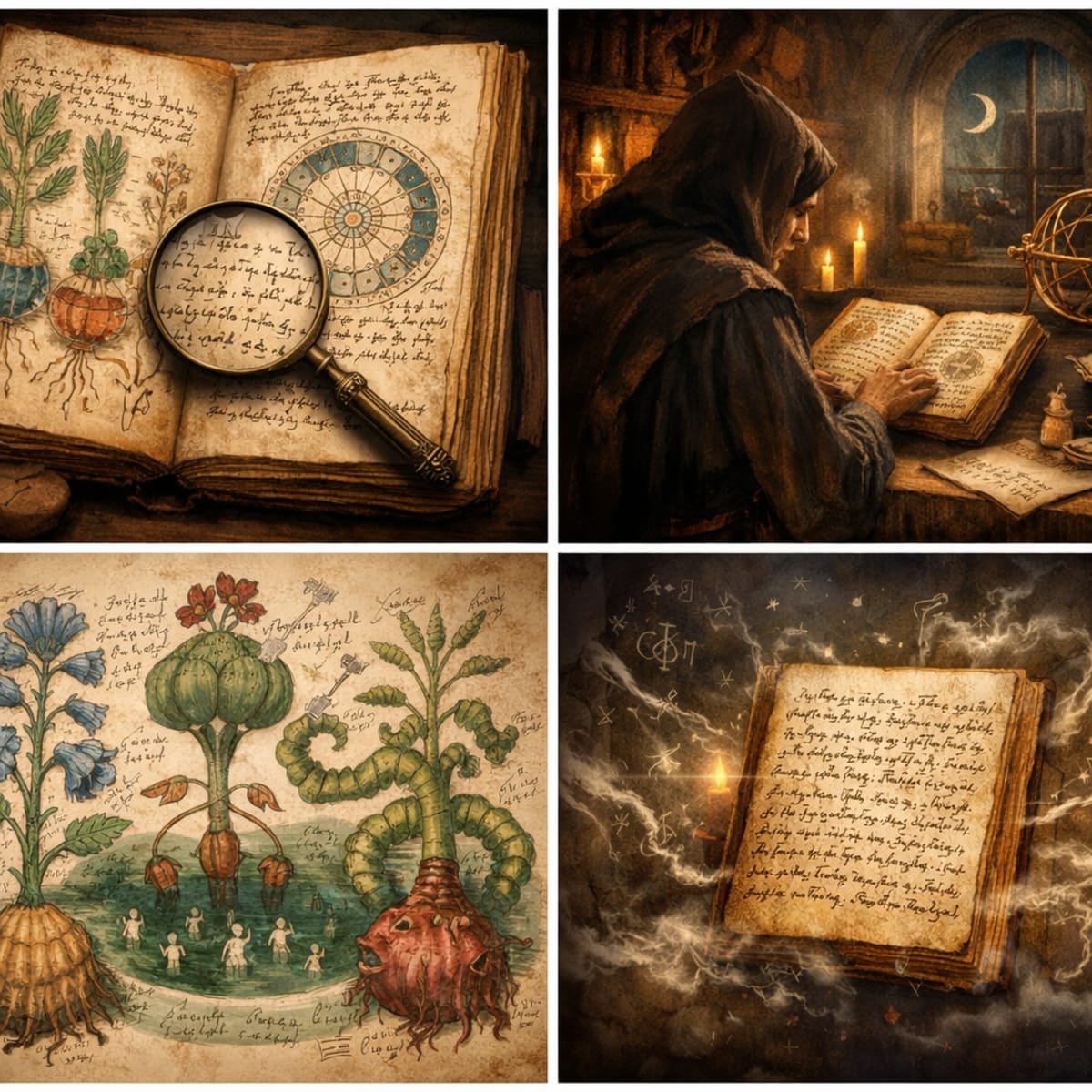
It appears to be written in a consistent script, with regular spacing, grammar-like repetition, and internal logic. The illustrations suggest sections devoted to botany, astronomy, biology, cosmology, and medicine—yet none of the plants, diagrams, or symbols correspond cleanly to known traditions.
It looks medieval. It behaves like a real language. And yet, it belongs nowhere.
The Hostile Witness
Here’s where the manuscript turns hostile.
No known language fits the text. Not Latin, not Hebrew, not Arabic, not a ciphered European tongue. Statistical analysis shows structure—but not meaning.
The illustrations are equally deceptive. The plants resemble real species, but only in fragments, as if remembered badly or reconstructed from rumor.
The text is too consistent to be nonsense. Word frequency, repetition patterns, and syntax-like behavior rule out random gibberish. Furthermore, there are no corrections. No crossed-out words. No visible hesitation. Whoever wrote it knew exactly what they were doing.
Even modern technology has hit a wall. Machine learning models trained on every known language family still fail to map it meaningfully. The manuscript behaves like a language designed to look readable while actively denying comprehension.
The Theories
Scholars have proposed five main theories to explain the book. Every explanation fits part of the manuscript, but none of them survives the whole.
1. A lost or unknown language
Some believe it represents a now-extinct language, possibly regional or ritualistic.
- The Problem: No corroborating texts exist. Written languages don’t usually vanish without leaving fossils.
2. A sophisticated cipher
Perhaps it is an encrypted text using an unknown system.
- The Problem: No known cipher produces this level of linguistic realism without eventual leakage.
3. A hoax
An elaborate medieval prank meant to deceive wealthy collectors.
- The Problem: Creating this would require linguistic insight centuries ahead of its time—and offered no clear payoff for the creator.
4. Alchemical or esoteric shorthand
A text meant only for initiates, using layered symbolism rather than literal language.
- The Problem: Even esoteric texts have anchors to reality. This one remains unmoored.
5. A constructed language
An early attempt at inventing a private language.
- The Problem: If so, it is far more advanced than any known medieval conlang—and far too disciplined.
A Warning, Not a Puzzle?
The Voynich Manuscript may not be unreadable by accident. It may be unreadable by design—a book meant to store knowledge without revealing it. A filter rather than a message.
It is a text that assumes the wrong reader will eventually arrive, and so it refuses to cooperate.
Or worse: It is a text that was perfectly readable once, written for a world that no longer exists.
This leaves us with uncomfortable questions. What if the Voynich Manuscript isn’t a puzzle, but a warning? What if it encodes meaning in a way modern minds are incapable of recognizing? And most unsettling of all: What other texts like this were lost because they weren’t lucky enough to survive?
If you had the manuscript in your hands, would you try to decode it… or would you accept that some knowledge resists being spoken aloud?