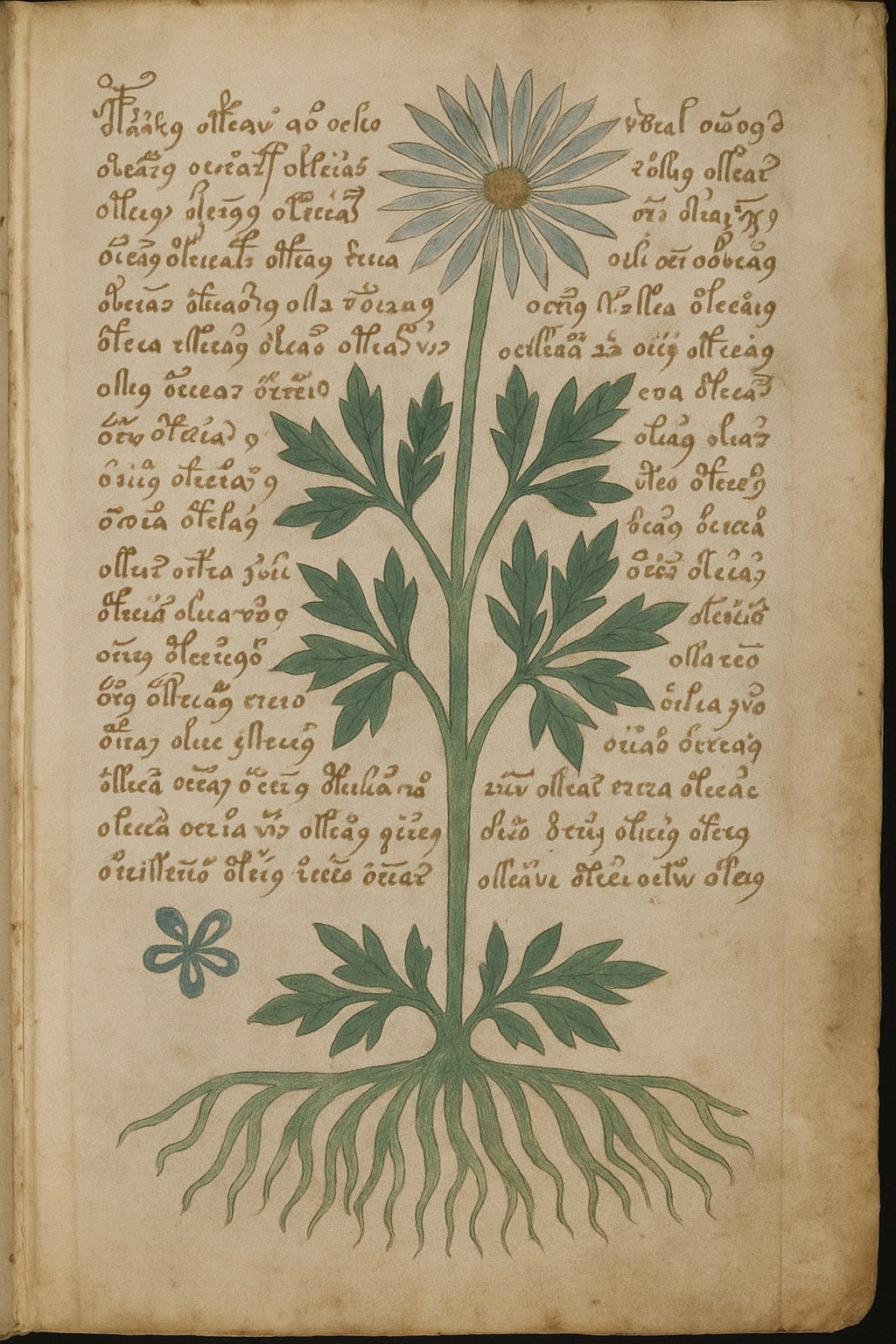
What modern science has actually confirmed about the Voynich Manuscript — and why the results are stranger than the myths.
In the years since I wrote about the Voynich Manuscript's history and the theories surrounding it, the question I receive most often isn't about the cipher or the chimeric plants or the uncharted constellations. It's a simpler, more fundamental question: how do we actually know the thing is real?
It's a fair challenge. The internet has layered so much mythology over this manuscript — alien contact, elaborate medieval pranks, occult conspiracies — that the artifact beneath the noise has become almost impossible to see clearly. So I want to set the speculation aside entirely and look at what the physical object has been put through: the instruments, the laboratories, the chemical signatures, the statistical models. The hard forensics.
What the science confirms is, in its own way, more unsettling than any of the myths.
What the Vellum Tells Us
For most of the twentieth century, the simplest way to dismiss the Voynich Manuscript was to call it a forgery. When the Polish book dealer Wilfrid Voynich acquired it from an Italian Jesuit college in 1912, skeptics immediately suggested he had fabricated it to extract money from wealthy collectors. It was a tidy theory. A modern fake meant the unreadable script was just a parlor trick, a meaningless jumble dressed up to look ancient. No real mystery, no real problem.
In 2009, that theory was put to a formal test.
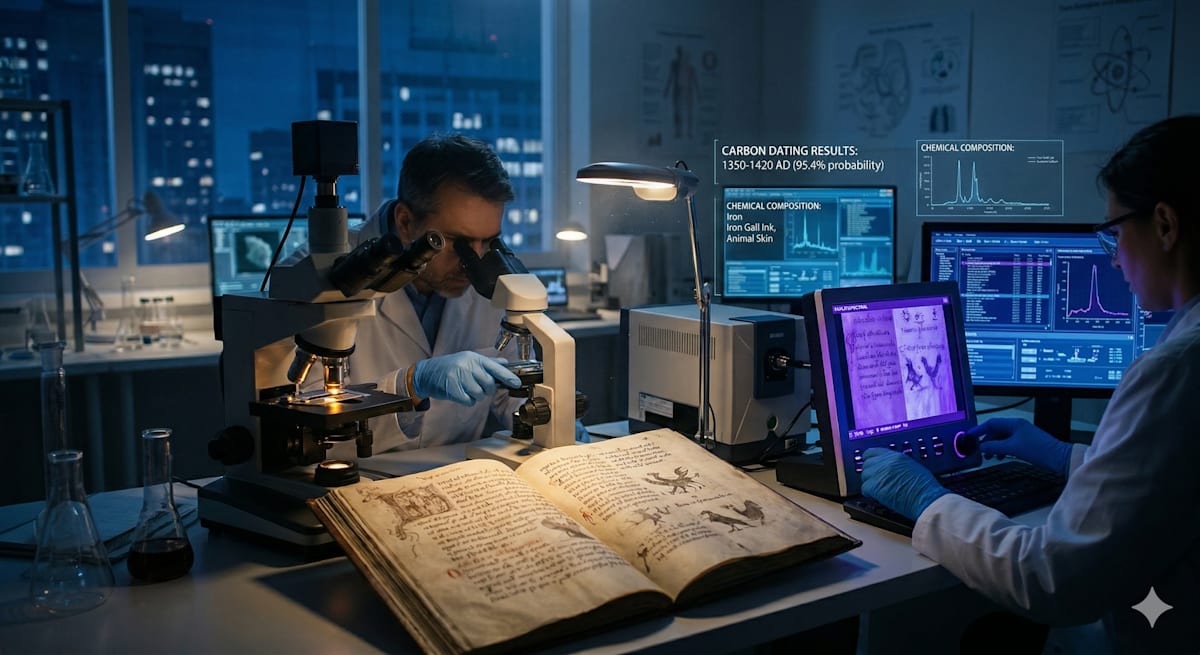
A research team led by Dr. Greg Hodgins at the University of Arizona was granted permission to take four small samples from the manuscript's vellum pages and subject them to accelerator mass spectrometry — a technique that measures the precise decay rate of Carbon-14 isotopes in organic material. The results placed the creation of the vellum in a specific window: between 1404 and 1438. The margin of error was narrow. The finding was mathematically sound and has been universally accepted by the scientific community.
The forgery hypothesis, however, had a remaining escape route: a sufficiently committed faker could have sourced genuine 15th-century parchment and simply applied modern ink. To close that loophole, researchers turned to the McCrone Research Institute in Chicago for a rigorous chemical analysis of the manuscript's pigments and script.
Using polarized light microscopy and energy-dispersive X-ray spectroscopy, the forensic chemists mapped the chemical signatures of every element of the manuscript. They found no modern artificial pigments. No titanium dioxide. No synthetic dyes of any kind. The script was written in iron gall ink; the illustrations were colored using ground minerals consistent with early Renaissance European practice. Everything matched the period the vellum suggested.
Then came the detail that I find most striking of all. Multispectral imaging — which reveals material beneath the visible surface of a document — found no underlying sketches, no erasures, no preliminary marks of any kind beneath the complex, flowing script. Whoever wrote it did so with complete fluency, applying ink to an expensive surface without hesitation or correction, as though transcribing something already fully formed.
The scientific consensus, taken as a whole, is this: the Voynich Manuscript is a genuine early 15th-century artifact. Its author spent years and considerable resources — vellum was not cheap — producing 240 pages of a text they wrote as naturally as any medieval scribe wrote Latin.
The question of what they were writing, of course, remains entirely open.
The Illustrations: A Taxonomy of Things That Don't Exist
When a text resists decipherment, analysts typically turn to its illustrations for purchase. Images, unlike encrypted language, are supposed to offer context — a Rosetta Stone of visual reference that can anchor the cipher to something recognizable. In the Voynich Manuscript, the illustrations do the opposite.
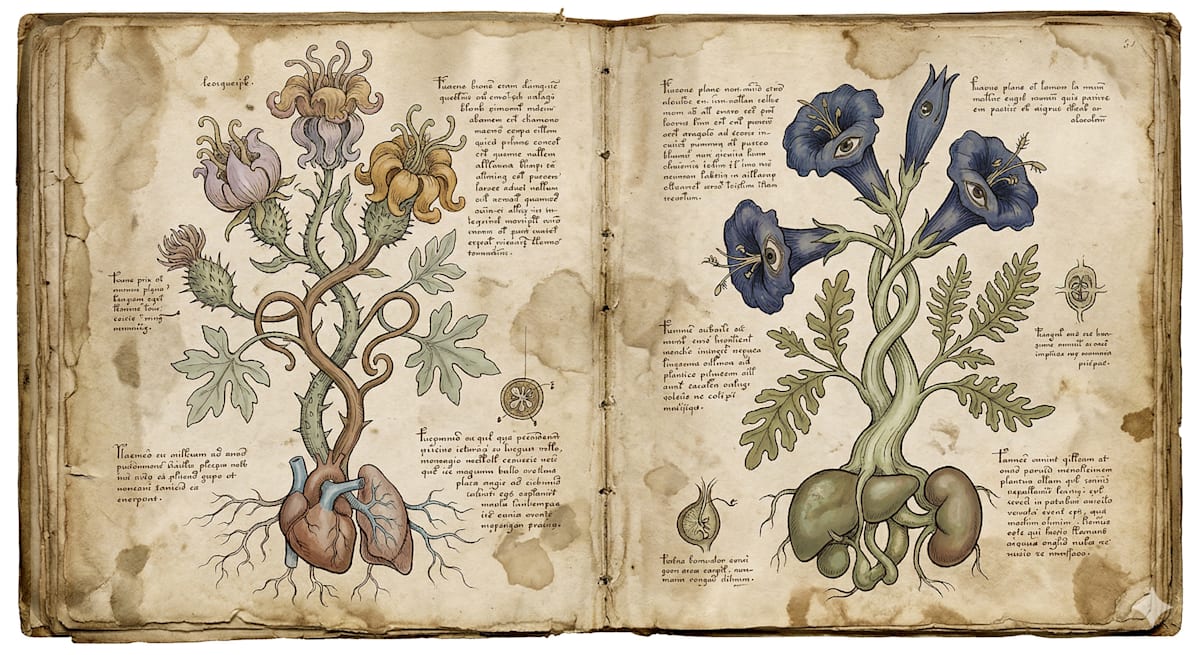
The botanical section, which comprises more than half the codex, contains detailed, carefully rendered drawings of over a hundred plant species. Generations of botanists and paleobotanists have searched European, Asian, and American historical records for matches. None have been found. The plants are not poorly observed real species; they are not primitive or naive renderings that might correspond to something known if you squint. They are meticulously executed composites — the root system of one recognizable plant attached to the stem of another, flowering with something else entirely. The root structures occasionally take on shapes that suggest anatomy more than botany: swollen, branching, sometimes faintly organ-like.
They were drawn with the confidence of direct observation. That is the part that doesn't resolve neatly into any comfortable explanation.
The astronomical section presents a different kind of problem. Zodiac symbols appear, which would suggest a conventional medieval celestial reference — except that they are embedded in concentric charts that don't correspond to any known astronomical tradition. The spatial arrangement of stars, moons, and suns follows a geometry that no 15th-century astronomer would have recognized as mapping anything real.
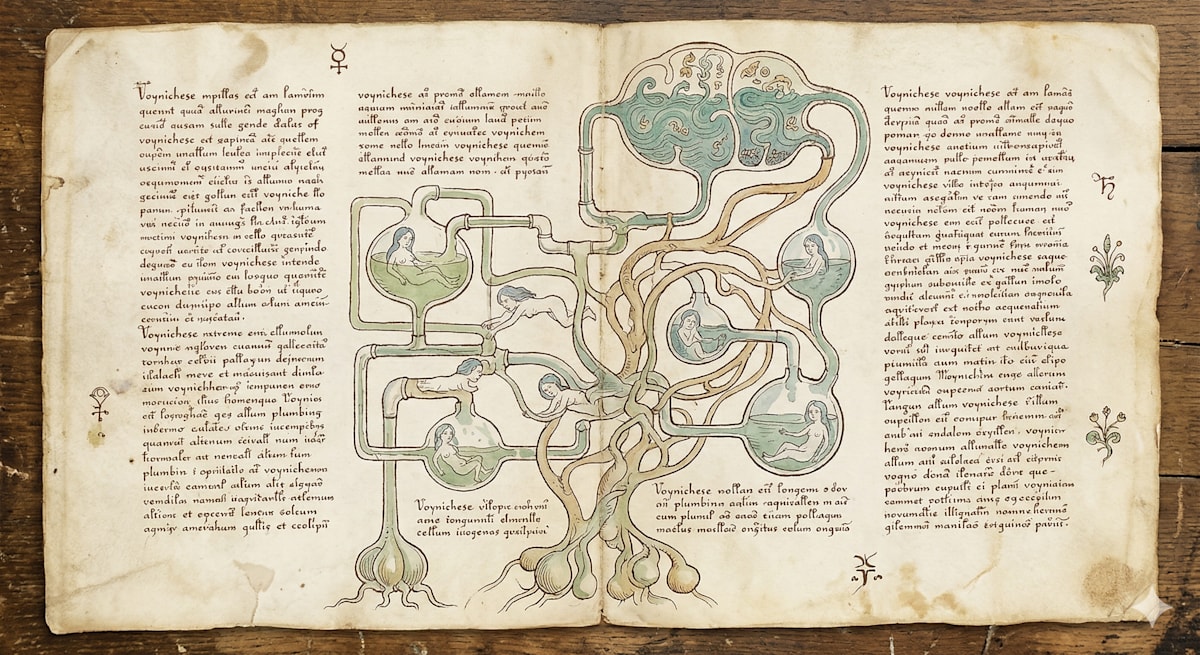
The section scholars call balneological is perhaps the strangest of all. It depicts dozens of small female figures moving through interconnected networks of tubes, channels, and pools filled with what appear to be colored fluids. The plumbing bears no resemblance to medieval baths or any known hydrological system. The shapes of the vessels — swollen, branching, vascular — look less like architecture than like the internal workings of something biological.
Taken together, the illustrations suggest an author who was documenting something. Not inventing decoratively, not illustrating known material in an idiosyncratic style, but recording a coherent system of knowledge — one whose categories (botany, astronomy, biology) map onto conventional medieval science, but whose specific content belongs to no tradition we can identify.
The Language: Structured, Fluent, and Unreadable
The illustrations are strange. The linguistics are something else entirely.
Written left to right in a flowing, consistent hand, the Voynich script uses roughly twenty-five to thirty distinct characters that appear in no other historical document. After World War II, William Friedman — the cryptanalyst who had broken Japan's PURPLE diplomatic cipher, arguably the most significant codebreaking achievement of the war — assembled a team of specialists and turned their full attention to the manuscript. They applied the most advanced frequency analysis of the era. They searched for substitution ciphers, transposition ciphers, every structural pattern their methods could detect.
They found nothing. The text yielded no underlying language.
Decades later, as computational power grew, the manuscript was processed by machine-learning models trained on every known language family. What those models returned was not the silence of random gibberish. It was something more confounding.
The Voynich text adheres to Zipf's Law.
In linguistics, Zipf's Law describes the statistical relationship between a word's frequency and its rank in any naturally occurring language: the most common word appears roughly twice as often as the second most common, three times as often as the third, and so on. This distribution emerges organically in all known human languages and cannot be convincingly faked — a random string of symbols produces a flat, chaotic distribution that fails the test immediately.
The Voynich text passes. The statistical distribution of its words matches the profile of a genuine natural language with a precision that eliminates random generation as an explanation. The algorithms confirm what Friedman's team intuited: this is a structured, internally consistent system of communication. It has the mathematical signature of real language.
It also has no punctuation. Almost no words exceed ten characters. And it shares no morphological roots — no recognizable word-building patterns, no grammatical fossils — with any known language family on earth. Indo-European, Semitic, Sino-Tibetan, Afroasiatic: the manuscript is unrelated to all of them. It is, statistically, a language. Linguistically, it is an island.
This is the bind that stops the scientific investigation cold. The mathematics prove that the author was communicating something specific and complex. The cryptography finds no key. The linguistics find no family. The manuscript is not a hoax — but neither is it readable. It is a locked system whose internal coherence we can measure without being able to access a single word of its content.
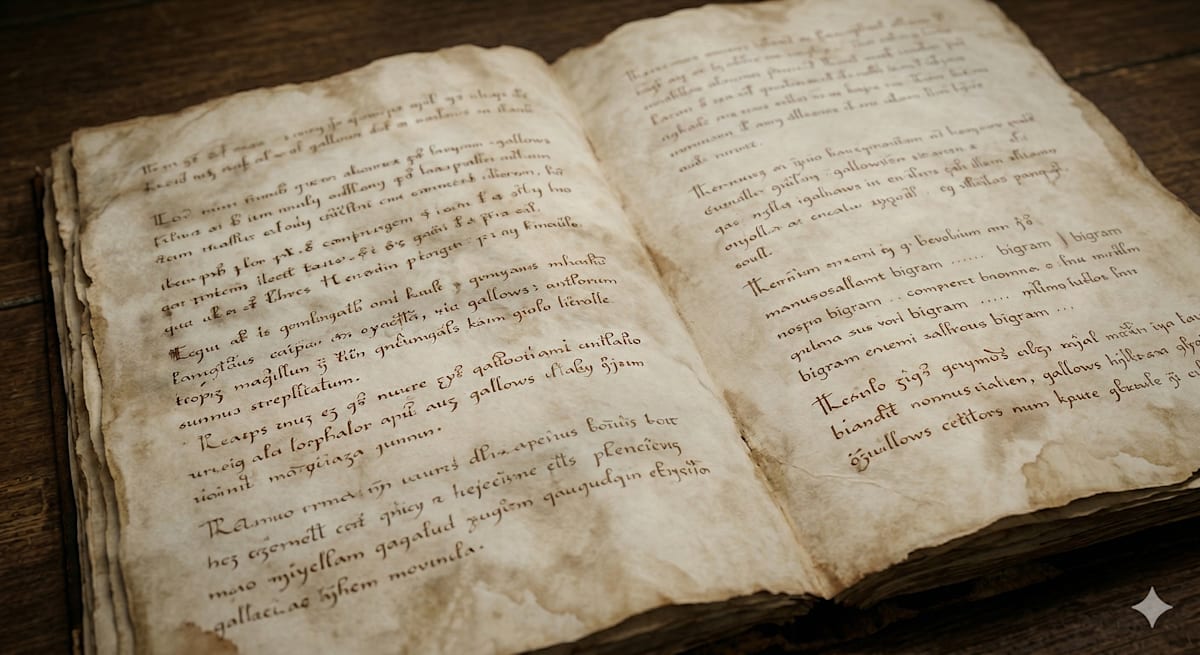
What the Evidence Actually Leaves Us With
I work as a bilingual translator. My days are spent inside the architecture of language — its load-bearing structures, the places where meaning is carried by grammar versus context versus cultural assumption, the points at which one system of thought resists clean conversion into another. I came to the Voynich Manuscript through that professional lens before I came to it as a novelist, and what strikes me most, looking at the forensic picture as a whole, is not the mystery of what it says.
It's the question of what kind of mind produced it.
The evidence rules out accident. It rules out casual deception. It rules out naive construction. What it leaves is an author in the early 1400s who wrote with complete fluency in a language that has no known relatives, illustrated a system of knowledge that has no known parallels, and did so on expensive material with the steady hand of someone who was not working something out — who was setting something down.
Historians and cryptographers, by the nature of their disciplines, have to stop at the wall the evidence builds. Without a key, the scientific method has nothing further to offer. The file stays open, and cold.
For me, that wall is where the interesting questions begin. My archaeological thriller The Voynich Key grew directly out of sitting with the forensic record and asking what it would mean if the evidence pointed exactly where it appears to point — if the author knew precisely what they were doing, and if whatever they were protecting was worth the effort of an entirely private language. What happens when 21st-century technology finally finds the mechanism that 600 years of human ingenuity could not?
If that question interests you, the novel is at authormichaelmill.com/books. The science in it is real. The history is verified. The conclusion is mine.