Nov 5, 2026 · @Michael Mill
Long before anyone filmed a ghost hunt in night vision, Greeks, Romans, Babylonians, and Egyptians were renting haunted houses at a discount, writing pointed letters to dead relatives, and hiring specialists to walk restless spirits back to the underworld.
Picture a real estate notice posted in Athens almost two thousand years ago. Large house. Plenty of rooms. Priced far below anything comparable in the city. The owners would like to sell or rent to anyone at all, and they would prefer that you ask no questions.
A traveling philosopher reads the notice and does what any of us would do when a spacious place downtown costs less than a storage unit. He gets suspicious. He asks around, and the neighbors tell him about the chains, the old man, and the people who stopped sleeping and then stopped living. The philosopher listens to all of it. Then he takes the house.
I have a soft spot for this man, and we will spend the night with him shortly. I expected ancient ghost stories to feel remote, wrapped in gods and omens that need a footnote every third line. What I found was more unsettling. The ancients told ghost stories the way we still tell them, with clanking chains, bargain rent, a skeptic who stays the night, and bones under the courtyard. They also had possession, exorcists, and a holiday when every Roman household tried to evict its dead with a handful of beans.
Some of what follows comes from poets and satirists, some from historians, and some from clay tablets written by working exorcists. I'll tell you which is which as we go.
Pliny's Haunted House in Athens: The Oldest Ghost Story Template
Our philosopher comes to us from Pliny the Younger (AD 61 to about 113), a Roman lawyer and senator. In Book 7, Letter 27, he writes to his friend Lucius Licinius Sura with a question that still fills late-night conversations. Do ghosts exist, with real shapes and some kind of power, or are they empty images that fear paints on the mind?
The house in Athens, Pliny says, was large and roomy, with a bad name and an unhealthy air. In the dead of night came the clank of iron and the rattle of chains, faint at first and then closer. Then came the figure: an old man, wasted and filthy, with a long beard and bristling hair, chains on his legs and wrists, which he shook as he walked. The tenants spent their nights awake and terrified. Sleeplessness brought sickness, and as the fear grew, death followed.
Enter Athenodorus. He read the notice, heard the price, and grew suspicious. He asked questions, learned the whole story, and rented the place anyway, apparently with enthusiasm.
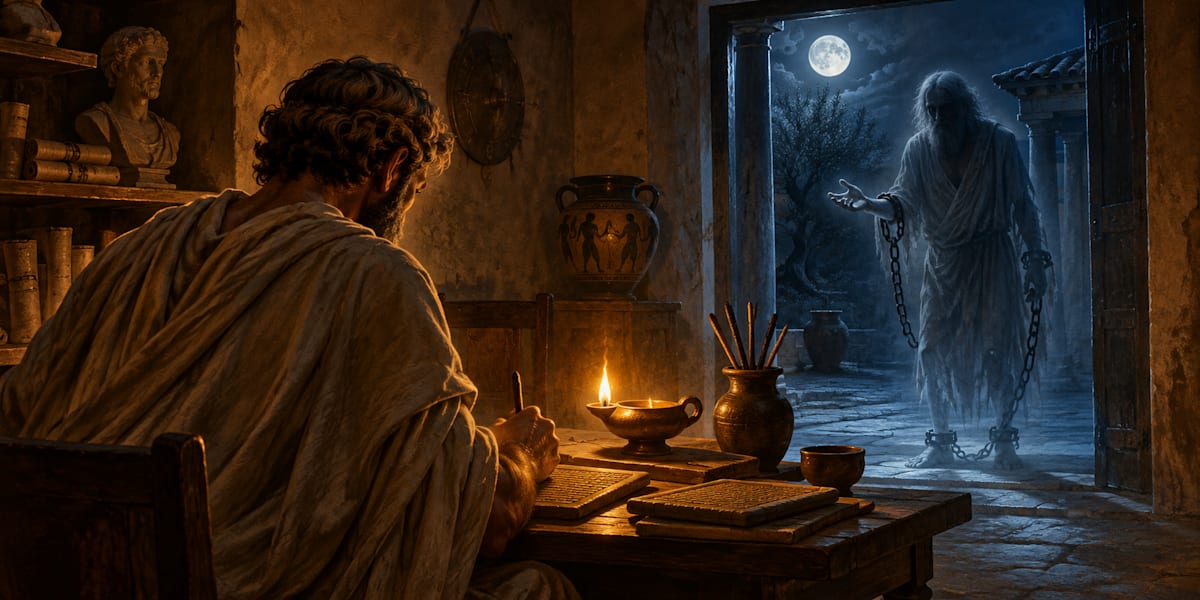
His method deserves a spot in every ghost hunter's manual. At nightfall he had a couch set up in the front of the house, called for writing tablets, a stylus, and a lamp, and sent his servants to the back rooms. Then he wrote, keeping his eyes, hand, and mind on his work so that an idle imagination would have no room to invent phantoms.
For a while there was only silence. Then iron clashed and chains rattled, closer and closer, until the sound was in the room. Athenodorus looked up. There stood the old man, beckoning with one finger. The philosopher raised a hand to signal that the ghost should wait a moment, and went back to his writing.
I want to stop and admire that gesture. A dead man in chains is summoning you in the middle of the night, and you hold up a finger like a clerk finishing a sentence.
The ghost, understandably, rattled its chains over his head. Athenodorus finally took his lamp and followed. The figure moved slowly, as if the chains weighed on it, turned into the courtyard, and vanished. Athenodorus marked the spot with a handful of grass and leaves. The next morning the magistrates had the ground dug up and found bones twisted together with chains, the flesh long since rotted away. The remains were buried at public expense, and the house was quiet from then on.
Pliny admits he believes this story on the word of others, then adds one from his own household. His freedman's younger brother woke to find someone sitting on his bed, cutting the hair from his head with shears, and in the morning the hair lay on the floor. Pliny closes by begging Sura to settle his doubts. Sura's reply, if he sent one, is lost. I like to imagine it was long and evasive.
Pliny never says who Athenodorus was, though many readers assume the Stoic Athenodorus of Tarsus, tutor to the young Augustus. Debbie Felton, in her 1999 study Haunted Greece and Rome, treats the tale as something close to the master template of the haunted house story. Read it again and count the parts that survive today: the bargain price, the ignored warning, the steady skeptic, the ghost that leads the living to its secret, the body, the proper burial, the silence afterward. Two thousand years of horror writers have been rearranging this furniture.
Lucian's Haunted House in Corinth
About two generations after Pliny, the satirist Lucian of Samosata wrote a dialogue called Philopseudes, or The Lover of Lies. A skeptic named Tychiades visits a sick friend and finds the bedroom crowded with distinguished philosophers trading supernatural tales. Then the most revered guest of all walks in.
His name is Arignotus, a Pythagorean with long hair and a solemn face, the kind of man people call "divine" with a straight face. Tychiades is relieved. Surely this sage will bring some reason into the room. Arignotus promptly tells the best ghost story of the afternoon.
There was a house in Corinth, he says, belonging to a man named Eubatides, near the district called the Craneum, empty for years because of a ghost. Arignotus moved in for the night with his Egyptian books of magic. The spirit came at him, changing shape again and again. He answered with his most terrible Egyptian spell, drove the thing into a dark corner, and watched where it sank into the ground. Workmen dug there in the morning and found the corpse of a murder victim, hidden without funeral rites. Once it was properly buried, the haunting stopped.
Then comes Lucian's sharpest joke. Arignotus tells the skeptic that next time he passes through Corinth he should look up the house, find the doorkeeper, a man called Tibius, and ask to see the very spot. Verification, ancient style: go ask the doorman.
Lucian meant the whole scene as mockery, and the joke works only if his readers already knew the plot by heart. Some scholars think he borrowed from Pliny. Daniel Ogden, in his 2007 book In Search of the Sorcerer's Apprentice, sees both writers drawing on a much older traditional tale, whose earliest version turns up on the Roman comic stage.
Plautus and Mostellaria: A Roman Haunted House Comedy
Around 200 BC (the exact date is disputed, and some scholars place it shortly after 193 BC), the playwright Plautus staged a comedy in Rome called Mostellaria, which we usually translate as The Haunted House. It was probably adapted from a lost Greek play by the Athenian comic poet Philemon, whose title, Phasma, simply means "The Ghost."
The plot is sitcom gold. While old Theopropides is away on business, his son Philolaches turns the family home into a nonstop party. Then the father comes home early. The clever slave Tranio locks the doors, hides the revelers inside, and meets his master in the street with a terrible story. A dead man, he says, appeared to the son in his sleep: a guest from overseas, murdered long ago by the owner of the house for his gold and buried secretly inside, without funeral rites. The father believes every word and stays out, which buys Tranio time for a string of further lies.
For the trick to land, the Roman audience had to recognize the ingredients instantly: the murdered stranger, the hidden body, the missing rites. Lacy Collison-Morley made the point in his 1912 book Greek and Roman Ghost Stories, observing that Plautus treats the ghost as stock stage machinery. Three centuries before Pliny wrote his letter, the haunted house was already a cliché.
Plutarch's Haunted Bathhouse and the Ghost of Caligula
Plutarch (about AD 46 to 120) spent most of his life in his hometown of Chaeronea in central Greece, and he opens his Life of Cimon with a local scandal.
In the early first century BC, while Roman troops wintered in the town, the commander of a cohort became obsessed with a proud young local named Damon and seemed ready to take by force what Damon refused him. Damon and his friends smeared their faces with soot, ambushed the officer at dawn, and killed him, then fled. The town later lured Damon back with honors, and he was murdered while anointing himself in the steam room of the public baths.
For a long time afterward, Plutarch writes, phantoms were seen there and groans were heard, so the townspeople walled up the door of the steam bath. Even in his own day, neighbors believed that strange sights and alarming sounds came from behind the bricks. Damon's descendants, he adds, were still known as the Asbolomeni, "the sooty ones."
Rome had its own badly buried dead. When the emperor Caligula was assassinated in AD 41, his body was carried in secret to the Lamian Gardens on the Esquiline Hill, half burned on a hasty pyre, and covered with a little turf. Suetonius, writing around AD 121, reports that the caretakers of the gardens were troubled by ghosts, and that the house where Caligula died had some fresh terror every night until it burned down. The trouble seems to have ended only after his sisters returned from exile, dug him up, cremated him properly, and gave him a tomb.
Suetonius wrote eighty years after the murder and loved court gossip. Still, look at what the gossip chose to say: even a hated emperor, shoveled into a half-finished grave, had the right to come back and complain.
Why Ancient Ghosts Returned: The Unburied and the Untimely Dead
By now you can probably see the pattern, and so could the ancients. The dead who returned were the ones whose deaths had gone wrong.
Homer laid out the rule early. In the Iliad, the ghost of Patroclus comes to Achilles in a dream and begs for a quick burial, because the other shades will keep him from entering the house of Hades until he has one. Greek writers later named the troublesome dead: the aōroi, the "untimely," who died young or unmarried, and the biaiothanatoi, who died by violence. Add the unburied, and you have nearly every ghost in this article.
The ancients even found a use for this unhappy population. About 1,600 curse tablets survive from the Greek and Roman world: thin lead sheets scratched with names and demands, often pierced with nails, and hidden in wells, sanctuaries, and the graves of the young or violently dead. As the epigrapher David Jordan explained in a 1985 survey, the untimely dead were thought to linger near their tombs, ready to carry a curse down to the gods below.

Mesopotamian Ghosts and the Oldest Known Drawing of a Ghost
To find the beginning of the story, we have to leave Greece for Mesopotamia, where people wrote about ghosts long before anyone wrote about Athens.
The Sumerian word for a ghost was gidim, borrowed into Akkadian as eṭemmu. Irving Finkel, a British Museum curator and one of the world's leading readers of cuneiform, traces the sign to a tablet from the early third millennium BC. Mesopotamian ghosts lived in a dim, dusty underworld and depended on their families for offerings of food and cool water, poured down a pipe into the grave. A neglected ghost went hungry, and a hungry ghost came home.
When it did, it came as illness: headaches, ear and eye trouble, dizziness, fever, confusion of the mind. Some ghosts entered through the ear, and one way of writing the word, Finkel notes in his 2021 book The First Ghosts, can be read as "ear-opener." The ghost of someone who drowned caused shortness of breath. An omen collection called If a City warns that if a ghost enters a man's house, the owner will die.
So the Mesopotamians had haunted houses too, and professionals to deal with them. The exorcist, or āšipu, made a clay figure of the ghost, set out offerings to the gods, then buried the figure and poured water over it, sending the ghost home with some dignity.
My favorite piece of evidence sat misread in the British Museum's storerooms from the nineteenth century until 2021. It is a Babylonian clay tablet about 3,500 years old, small enough to fit in your palm, with instructions for dealing with a ghost that seizes a person and refuses to let go. Under a lamp held at the right angle, Finkel spotted a faint drawing on it: a tall, thin, bearded man with his hands tied, led along by a woman. "It's obviously a male ghost and he's miserable," Finkel told The Observer in 2021.
The ritual calls for figurines of a man and a woman, dressed and set up facing the sunrise, with offerings and a prayer. As Finkel reads it, the diagnosis was loneliness: once a bride led this ghost down to the underworld, he would leave the living in peace. I can't think of a more human piece of magic. Three and a half thousand years ago, someone looked at a gloomy specter hanging around the house and concluded that what he really needed was a date.
Ancient Egypt: Letters to the Dead and a Restless Ghost
The Egyptians did most things on a grand scale, but some of their most moving evidence about the dead is small and domestic: the Letters to the Dead, around two dozen messages from the Old Kingdom to the Late Period, written mostly on pottery bowls and left at the tomb.
They read like letters to a relative who has moved away and stopped answering, asking for help with illness, inheritance quarrels, and children who refuse to come. A bowl from Qau, now in the Petrie Museum in London and dated to about 2100 to 2050 BC, carries a man's appeal to his late parents over a family dispute. On a bowl in Cairo, a woman named Dedi asks a dead man for help with a sick servant and adds a pointed reminder: if this goes on, who will pour out water for you? As the Egyptologist Julia Troche observed in 2018, the dead stayed active members of the family, with duties they could be reminded of.
Egypt also gives us one of the oldest ghost stories with a plot, Khonsuemheb and the Ghost. It survives in pieces on four ostraca found around the Theban necropolis between about 1880 and 1905, and it dates from the Ramesside period, roughly 1186 to 1077 BC.
The High Priest of Amun, Khonsuemheb, calls on the gods from his rooftop and summons a restless spirit, who introduces himself with full credentials: Nebusemekh, son of Ankhmen and the lady Tamshas. His complaint is a housing problem. His tomb has collapsed, the winter wind blows straight through, and nobody remembers where he lies. Khonsuemheb promises a new tomb and a gilded coffin of ziziphus wood. The ghost stays unconvinced, and the priest sits down beside him and weeps. Eventually his men find the place, twenty-five cubits from the royal causeway at Deir el-Bahri. Then the text breaks off.
What strikes me is the tenderness of it. Nebusemekh is a displaced person with a leaky roof, and the most powerful priest in Thebes treats his complaint as a debt that must be paid.
Necromancy in Ancient Greece: Consulting the Oracle of the Dead
Most ghosts in these stories show up uninvited. Some people went looking.
The founding scene is in Book 11 of the Odyssey, where Odysseus digs a pit at the edge of the world, pours out offerings and the blood of sacrificed sheep, and waits while the shades crowd forward to drink, because only after drinking can they speak. Greeks who wanted the same conversation without the sea voyage could visit an oracle of the dead.
Herodotus, writing in the fifth century BC, tells the most disturbing story about one. Periander, tyrant of Corinth in the sixth century BC, sent messengers to the Oracle of the Dead on the river Acheron to ask his dead wife Melissa where a friend's deposit had been hidden. Melissa, whose death Periander had caused, refused. She was cold and naked, she said, because the clothes buried with her had never been burned. As proof of identity she added that Periander had put his loaves into a cold oven, a euphemism, Herodotus makes clear, for violating her corpse. Periander summoned the women of Corinth to the temple of Hera in their finest clothes, had them stripped, and burned the garments for Melissa. On the second consultation, she told him where the treasure was.
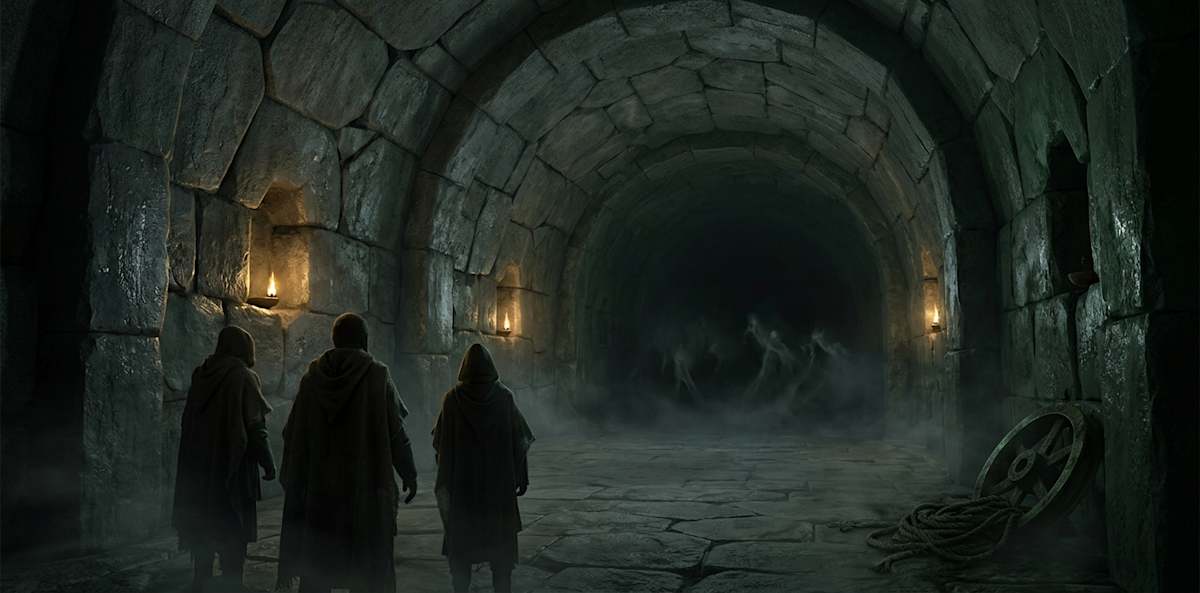
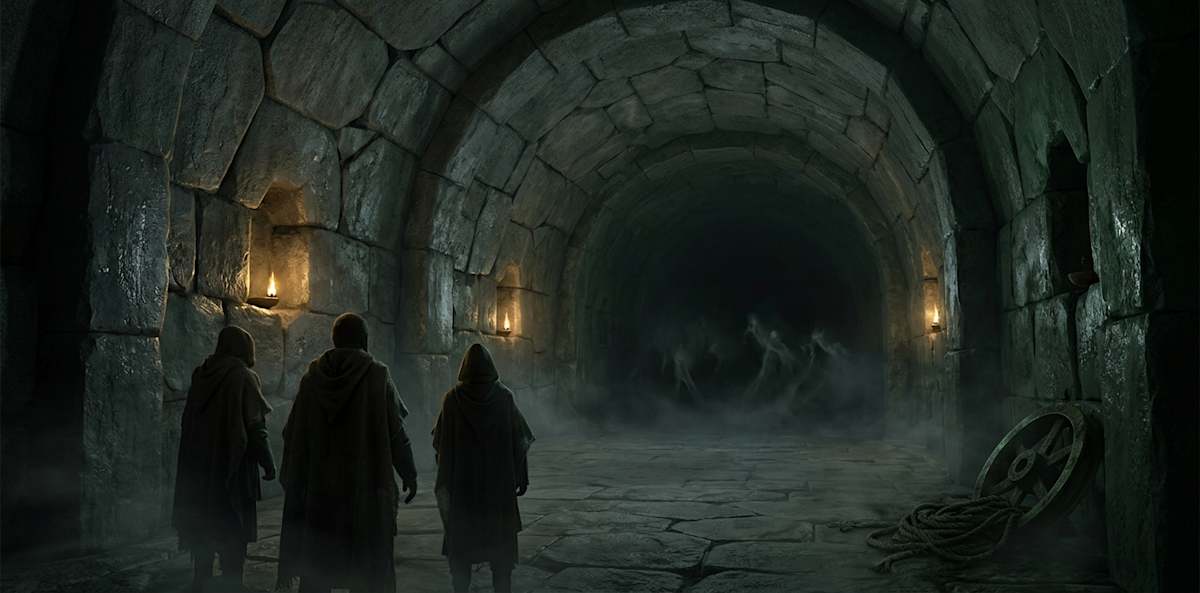
Where was that oracle? In 1958 the Greek archaeologist Sotirios Dakaris began digging a hilltop above the Acheron and announced that he had found it: massive polygonal walls, winding corridors, a vaulted underground hall. He imagined pilgrims fed on broad beans and lupine seeds, led through a dark maze, and he read the bronze wheels he found as parts of a machine for raising apparitions. The German scholar Dietwulf Baatz later identified twenty-one bronze washers from at least seven catapults. Together with storage jars and farm tools, they point to a fortified Hellenistic farmhouse, which is how most archaeologists now read the site. The underground hall is still cold and dark, and I would still rather skip a night there on raw beans.
Sparta, too, had professionals on call. Later Greek tradition, preserved by Plutarch among others, held that the regent Pausanias, victor over the Persians at Plataea, haunted the temple of Athena where his countrymen had walled him in and starved him for treason. To lay him, the Spartans brought in psychagōgoi, "soul-guides," from Italy.
Lemuria: How Romans Drove Ghosts Out of the House
The Romans, a practical people, put their hauntings on the calendar. Every May, on the ninth, eleventh, and thirteenth, the dead came back for the Lemuria, and every household dealt with them in person.
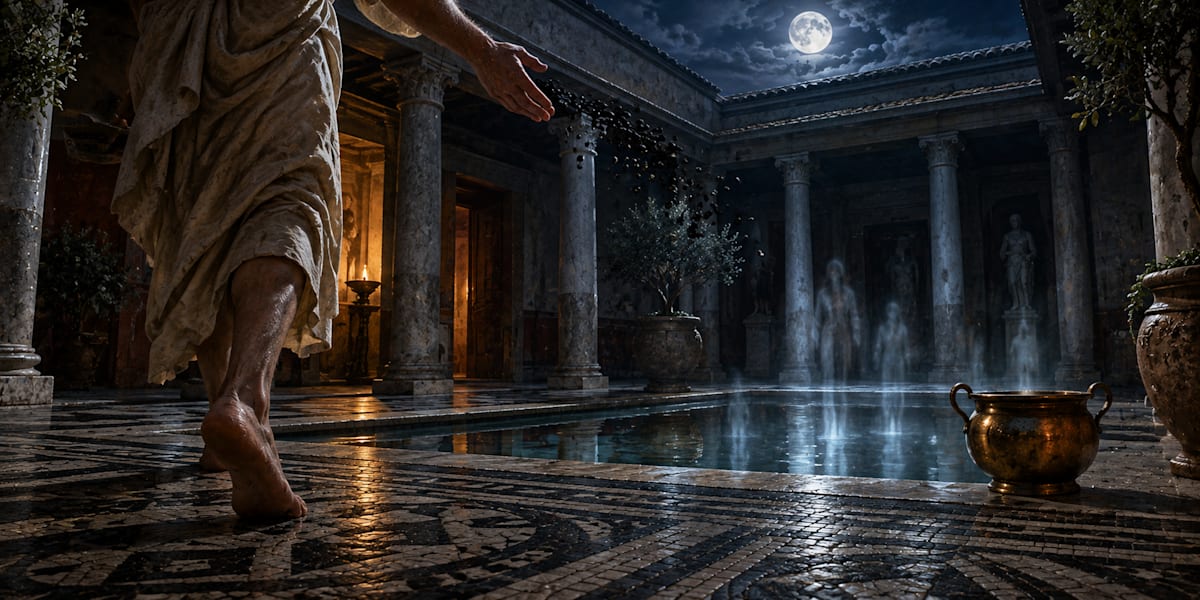
Our only detailed description comes from Ovid's calendar poem, the Fasti, written in the early first century AD. At midnight the head of the family rises, barefoot, and makes a protective sign with his thumb tucked between his closed fingers. He washes his hands in spring water, takes black beans, turns his face away, and throws them behind him, saying nine times that with these beans he redeems himself and his family. The unseen ghost is believed to follow and gather them. He washes again, bangs bronze vessels together, and nine times orders the shades of his fathers out of the house. Only then does he look back.
The Roman dead had gentler festivals too, with flowers and family meals. The lemures of May were the hungry, nameless, restless ones, and the classicist Fanny Dolansky, in a 2019 study, ties the rite to the untimely dead. At midnight in May, the family paid them off and showed them the door.
Possession and Exorcism in the Ancient World
A haunted house is bad enough. A haunted body is worse.
The Mesopotamian ghosts that slipped in through the ear were already a form of possession, and the idea traveled. In Philostratus's Life of Apollonius of Tyana, completed after AD 217, a mother begs the sage to help her sixteen-year-old son, possessed for two years by a spirit that claims to be the ghost of a soldier killed long ago, still passionately attached to his wife. It has threatened to throw the boy off a cliff if she seeks a cure. Apollonius hands her a letter addressed to the ghost, full of threats. Even exorcism, apparently, could be handled by mail.
The Jewish historian Josephus, writing his Jewish Antiquities in the 90s AD, claims he saw a man named Eleazar free possessed people in front of Vespasian, his sons, and his soldiers. Eleazar held a ring containing a root prescribed by King Solomon under the sufferer's nose and drew the demon out through the nostrils. For proof, he set a basin of water nearby and ordered the departing demon to knock it over. It did. The Methodist commentator Adam Clarke, reading the passage in the early nineteenth century, suspected a conjuring trick, which remains the first response most of us reach for. Either way, that basin is the ancient ancestor of the slammed door and the flickering lightbulb.
Why the Dead Kept Coming Back
Line these stories up across three thousand years and half a dozen cultures, and one rule runs through them all. The dead come back when the living fail them: when they lie unburied, shiver in a collapsed tomb, die young or murdered, or go without the water their family owed them. A ghost was the visible form of an unpaid debt, and the cure was nearly always the same. Find the body, honor it, feed it, give it a proper home.
That may be why Athenodorus never panics. What he brings is a clear head and a sense of duty. The ghost has a problem. The philosopher keeps writing until the problem shows itself, follows it into the courtyard, and sends for a shovel in the morning.
It may also be why these stories still work on us. Nearly everyone knows a house that holds something unfinished, a room nobody likes to enter, a name the family avoids. The ancients gave that feeling a beard, a set of chains, and a forwarding address in the underworld.
As for me, I've learned my lesson. If I ever find a spacious house at a suspiciously low price, I'll bring a lamp, a notebook, and a shovel. And I'll check the courtyard first.